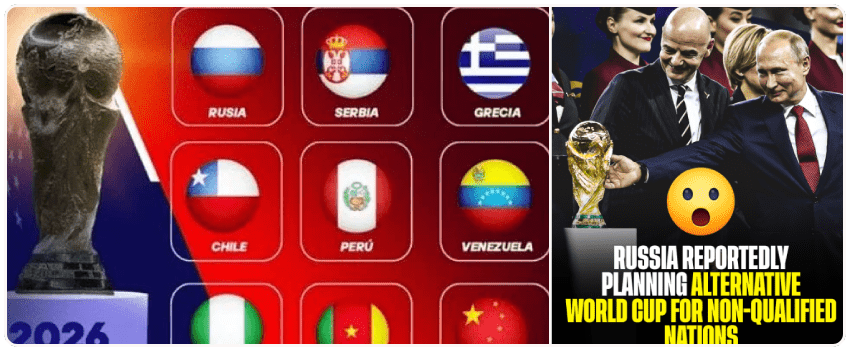
The global football community is currently digesting reports that the Russian Football Union (RFU) is exploring a parallel, invite-only tournament for national teams that fail to qualify for the 2026 FIFA World Cup.
While the prospect of a “shadow World Cup” is intriguing, it is crucial to distinguish between unconfirmed media reports and the hard logistical realities of international football. As of November 25, 2025, there is no official RFU confirmation, and early denials have appeared in Russian media. Significant regulatory hurdles suggest such an event would be nearly impossible to stage at a competitive level.


Here is a fact-checked breakdown of what is being reported, the confirmed status of Russia’s football exile, and the feasibility of an alternative tournament.
What’s being reported
Several outlets, including English-language explainer World Soccer Talk, 365Scores, and South Korean business outlet Chosun Biz, have reported that the RFU is developing a concept for a tournament to be held in the summer of 2026. The premise is straightforward: invite high-profile nations that miss out on the expanded 48-team FIFA World Cup in North America to play in Russia instead.
According to these reports, the initiative is designed to restore Russia’s international visibility and utilize the infrastructure left over from the 2018 World Cup. The proposed timing would see the event run alongside the FIFA World Cup, effectively acting as counter-programming.
However, the status of this project remains nebulous. There has been no official press release or statement from RFU President Alexander Dyukov confirming the plan. In fact, conflicting reports have emerged: Russian outlet Sportbox, citing an RFU source, has denied any plan to stage such a tournament; Swiss daily Blick likewise reports the idea is only at a planning/rumor stage. Treat it as a reported proposal until an RFU release, invitations, dates, and venues appear.
The Hard Facts To Anchor The Rumor
To understand the context of these reports, we must look at the verifiable status of Russian football and the 2026 schedule:
- Russia’s Ban: The Russian national team and clubs remain suspended from all FIFA and UEFA competitions following the invasion of Ukraine in February 2022. This ban was upheld for the 2026 cycle, meaning Russia was excluded from the UEFA qualifying draw and cannot participate in the World Cup itself.
- World Cup Dates: The 2026 FIFA World Cup is scheduled to run from June 11 to July 19, 2026, hosted jointly by the United States, Canada, and Mexico.
- Infrastructure: Russia possesses FIFA-grade stadiums from 2018, such as Luzhniki (Moscow) and Krestovsky/Gazprom Arena (St. Petersburg), that are currently underutilized for international events.
These facts create the environment for the rumor: a banned nation with empty world-class stadiums during the biggest window in global sports.
What Such A Tournament Would Run Up Against
While the idea of a parallel tournament is simple, the execution faces a massive regulatory wall: the FIFA International Match Calendar and player release rules.
Under FIFA’s Regulations on the Status and Transfer of Players (Annex 1), professional clubs are only obliged to release their players to national teams during specific “international windows” or for the final competitions of FIFA-sanctioned tournaments. FIFA’s Council set the mandatory World Cup 2026 release period to start 25 May 2026 (final on 19 July). That obligation does not extend to non‑FIFA events.
A “parallel tournament” organized by the RFU would not be an official FIFA event. Therefore:
- No Release Obligation: Clubs in Europe’s top five leagues (Premier League, La Liga, etc.) would be under no obligation to release players. They would almost certainly refuse to do so to protect their assets from injury in a non-sanctioned exhibition.
- Squad Quality: Even if a nation like Serbia or Chile accepted an invite, they would likely be forced to field a “B” or “C” team composed entirely of domestic league players, as their stars in Europe would be blocked by their clubs.
- Sponsorship & Broadcast: Global broadcasters and sponsors heavily invested in the FIFA World Cup would be contractually restricted or commercially disincentivized from supporting a rival event, limiting the potential revenue and reach.
Who might play? The names floated vs. reality
Media wish-lists (none confirmed) have floated potential invitees—nations that are historically strong but at risk of missing the 2026 cut, or those with friendly political ties to Russia.
Countries repeatedly mentioned in reports by World Soccer Talk and Chosun Biz include:
- South America: Chile, Peru, Venezuela
- Europe: Serbia, Greece
- Africa: Nigeria, Cameroon
- Asia: China
The Reality Check: Listing these teams is speculative. For example, if Serbia or Nigeria fail to qualify for the World Cup, their federations would still face immense political pressure from FIFA and UEFA not to legitimize a breakaway event. Furthermore, fielding a weakened team (due to the player release rules mentioned above) might damage their own brands.
Currently, no national federation has confirmed receipt of an invitation or an intention to participate.
Why Russia would try this and what it signals
From Moscow’s perspective, even floating the idea serves a strategic purpose. Russia’s friendlies since the 2022 ban have ranged from an 11–0 rout of Brunei in November 2024 to a 1–1 draw with Peru on November 12, 2025, and a 0–2 loss to Chile on November 15, 2025.
Staging a tournament during the World Cup would be an attempt to:
- Demonstrate Normalcy: Show domestic audiences that Russia is not isolated and can still host international guests.
- Soft Power: Strengthen ties with nations in the “Global South” or BRICS bloc who feel marginalized by Western-dominated sports governance.
- Pressure FIFA: Signal that excluding Russia leads to fragmentation of the football ecosystem, even if that fragmentation is minor.
However, the risk of embarrassment is high. If invited nations decline, or if the tournament is played in empty stadiums with third-string players, it could highlight Russia’s isolation rather than alleviate it.
Bottom line
As of late November 2025, the “Russian Parallel World Cup” is a media report, not a scheduled reality. While the RFU has the infrastructure to host games, the regulatory stranglehold of FIFA’s player release rules makes a competitive, high-profile tournament nearly impossible to execute.
Unless the RFU issues a formal concept and participating nations break rank with FIFA to attend, this story represents a political signal rather than a viable sporting event. Watch for an official statement from the RFU in the coming weeks; silence likely indicates the idea has been shelved.
Quick Fact Box
- Status: Reported concept; no official RFU confirmation as of Nov 25, 2025.
- Context: Russia suspended from FIFA/UEFA competitions since 2022; excluded from 2026 World Cup qualifying.
- 2026 World Cup Dates: June 11 – July 19, 2026 (USA/Canada/Mexico).
- Key Hurdle: Professional clubs are not obliged to release players for non-FIFA, off-calendar events, making full-strength squads impossible.
Also Read: Premier League Clubs Hit Hardest by AFCON 2025 Absences
Frequently Asked Questions
Is this tournament officially confirmed?
No. As of November 25, 2025, the Russian Football Union (RFU) has not officially announced this tournament. It relies currently on media reports and leaks.
Has any federation accepted an invite?
No—none have publicly confirmed receiving or accepting an invitation as of late November 2025.
Can clubs stop players from going?
Yes. Because this tournament would fall outside of FIFA’s official competition statutes, clubs would have the legal right to block players from attending.
When is the actual 2026 World Cup?
The 2026 FIFA World Cup will take place from June 11 to July 19, 2026, across 16 cities in the United States, Canada, and Mexico.