
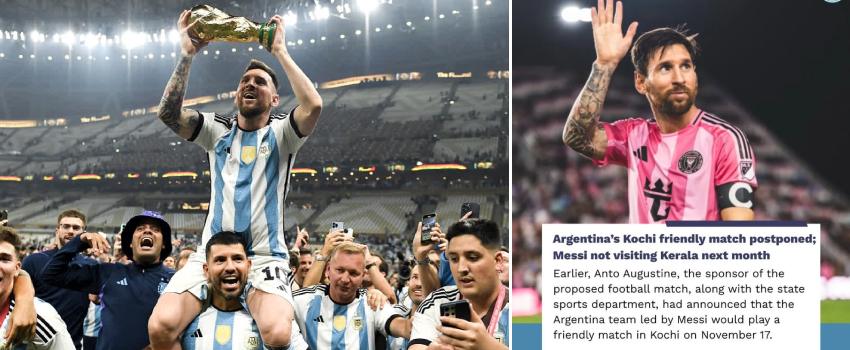
The dream of watching Lionel Messi and the World Cup-winning Argentina national team grace the pitch in Kochi, Kerala, India this November has been deferred. What started as an exciting local announcement—a high-profile international friendly slated for November 17, 2025, at the Jawaharlal Nehru International Stadium (Kaloor)—hit the wall of international football logistics and official clearances.
On October 25, 2025, the primary sponsor and coordinator, Anto Augustine of Reporter Broadcasting Company, announced that the match would not take place during the designated FIFA window due to a critical delay in receiving written approval from FIFA. A day earlier, the official scheduling commitments of the Argentine Football Association (AFA) had already established an Angola-only plan for the window. The November window plan for Kochi is off; organisers call it a postponement to a later window, but no new AFA-confirmed date exists yet. The entire saga underscores the immense difficulty of staging top-tier international football, where ambition must always yield to bureaucracy and scheduling certainties.


Quick Fact Box: Status of the Proposed Argentina Friendly
| Detail | Status as of Oct 27, 2025 |
| Planned Match Date/Venue | Kochi, Nov 17, 2025 (sponsor announcement) |
| Status for November | Postponed/Called off for November |
| Primary Reasons | Pending FIFA written approval; AFA confirmed Angola-only schedule |
| AFA Official Plan | Training in Spain; only friendly vs Angola in Luanda on Fri, Nov 14; back to Europe until Nov 18 |
| Opponent Status | None officially announced by AIFF/AFA; Australia booked U.S. games |
| Venue Works | ~Rs 70 crore upgrades; lighting tender pending; works continue |
| Financial Claims | Sponsor claims Rs 130 crore transferred to AFA; plus ~Rs 70 crore for renovations/logistics |
| FIFA Framework | International matches require authorisation per FIFA Statutes; no publicly cited “five-hour rule” |
Timeline and Key Actors: The Kerala Commitment
The groundwork for this ambitious event was laid earlier in the year. By June 2025, local authorities, including the Kerala Sports Minister V. Abdurahiman, confirmed that preliminary fee issues with the AFA had been resolved, with the target window set for October or November. The event was primarily coordinated between the sponsor, Anto Augustine, and the Kerala state sports department, including the Greater Cochin Development Authority (GCDA), which manages the stadium.
Local momentum picked up dramatically through September and mid-October. The promise of hosting the reigning world champions spurred significant effort at the Kochi stadium, which has been undergoing a comprehensive Rs 70 crore upgrade funded by sponsors and overseen by GCDA. This work was explicitly fast-tracked to meet “international standards” required for the match, including the necessary replacement of aging halogen floodlights.
However, despite this flurry of local activity, the international approvals failed to materialise. The cancellation announcement on October 25 confirmed that the race against time had been lost, bringing an abrupt end to weeks of anticipation.
The Competing Realities: Why November Became Impossible
The failure to stage the match in November stems from a combination of administrative delays and an immovable scheduling conflict.
1. The Definitive Scheduling Conflict (Angola-Only)
Perhaps the most conclusive reason was confirmed by the Argentine Football Association (AFA) itself. The AFA publicly communicated its definitive plan for the November window, which ruled out any possibility of a second match in Asia. The plan included:
- Training in Spain.
- A single friendly match against Angola in Luanda on Friday, November 14, 2025.
- A subsequent return to Europe to train through November 18.
This confirmed schedule, relayed by multiple international outlets, established a firm Angola-only plan that entirely eliminated the viability of the proposed Kochi friendly on November 17. The logistics simply made the India leg infeasible. The sponsor, Anto Augustine, also separately claimed that FIFA travel constraints, including an implied five-hour flight limit between fixtures, made playing both Angola and India in the same window impossible.
2. The Pending FIFA Approval
The second primary reason cited by both the organiser and the Kerala Sports Minister was the lack of written FIFA approval. To sanction any international friendly match, FIFA requires authorisation under its Statutes and Regulations Governing International Matches.
The FIFA Approval Framework International ‘A’ friendlies must be authorised under FIFA’s regulatory framework. In practice, this means the host Member Association (MA) and FIFA review documentation concerning match legitimacy and player insurance, verifying:
- Stadium Safety & Capacity: Audits confirming venue readiness, fire, and safety standards.
- Security Plans: Protocols for managing large crowds and protecting high-profile athletes.
- Broadcast Infrastructure: Confirmation that the venue meets minimum technical requirements.
- Match Operations: Ensuring neutral officiating and proper administrative protocols.
The Kerala Sports Minister V. Abdurahiman acknowledged that while stadium audits (including fire and safety) were completed and documents for clearance had been filed, final written FIFA clearance had not arrived in time. He also cited “minor issues,” including the pending tender for upgrading the aging halogen floodlights at the stadium—a necessary technical upgrade for a modern international broadcast.
Adding complexity, the minister also publicly alleged that emails sent by certain local individuals raising stadium concerns contributed to the delays. This remains an uncorroborated allegation but reflects the high level of scrutiny placed on international venues. Furthermore, the minister noted that an alternative, potentially safer venue, Thiruvananthapuram’s Greenfield Stadium, was rejected by organisers over issues with its field condition.
The Opponent: Confusion and Unconfirmed Status
One of the consistent points of ambiguity surrounding the November fixture was the identity of Argentina’s opponent.
Although the event was commonly referred to in local circles as “India vs. Argentina,” it is crucial to clarify that no official document from the AIFF (All India Football Federation) or the AFA ever confirmed India as the opponent.
Kerala authorities and local reports had referenced a generic “top international side,” or sometimes specifically mentioned Australia. However, Australia publicly booked U.S. friendlies that week (against Venezuela and Colombia), ruling them out for Kochi. Without an official AFA/AIFF confirmation or contract naming a specific opponent, the friendly was operating solely on local promotional momentum.
Stadium Readiness and Financial Chatter
The massive Rs 70 crore upgrade effort at the Jawaharlal Nehru International Stadium was meant to transform the venue. Authorities confirmed the works—which include significant renovations to meet international standards—will continue despite the November cancellation, per reports.
Regarding the finances, the sponsor, Anto Augustine, stated to local media that his company had transferred a massive Rs 130 crore to the AFA in June as part of the initial agreement, and had earmarked around Rs 70 crore for renovations and logistics within India. These figures must be presented as the sponsor’s public claims, as the AFA has not issued any financial confirmation. These immense numbers, however, underscore the staggering cost and financial risk involved in bringing the world’s best football team to India.
Also Read: ISL Tender: Four Bidders Attended AIFF’s Pre-Bid Conference
What’s Next: A New Date is Needed
Organisers and state officials have been quick to reassure fans that this is a postponement, not a cancellation. They have expressed intent to stage the match during the next available FIFA window, with some reports speculating on a target of March 2026.
However, as of today, October 27, 2025, no new date has been confirmed by the AFA.
For the match to successfully be rescheduled, several critical elements must align:
- AFA Schedule Alignment: Argentina’s official calendar must have an empty slot that works logistically with travel from their previous/next fixture.
- Full FIFA Clearance: All documentation, including completed lighting upgrades and final audits, must secure formal, written approval from FIFA far in advance.
- Official Opponent Confirmation: The AIFF and AFA must formally announce a confirmed opponent—whether it be the Indian national team or another side—to lock in the match details.
The lessons learned here are clear: in international football, paperwork and schedule alignment must always precede public announcement. The dream of hosting Messi remains alive, but it now requires a more patient, and far more meticulously planned, approach.